Whenever someone asks how I ended up here, I’m tempted to start from the end – from a set drenched in light, a robotic arm gliding a camera over a steaming bowl of ramen at 1/2000 of a second. The truth is harder. I started with nothing. No contacts, no mentor. Only curiosity, and a stubbornness that outlasted me.
I went to Asia young, carrying architecture with me and the belief that the world was made of proportions, materials, and light. Asia rearranged that belief almost immediately. I remember a cacao pod. Heavy, oval. Mahogany on one side, bruised purple on the other, orange running down its skin like a stripe. Split open, the smell was nothing like chocolate – milky, sweet, almost lychee – and the seeds sat in white pulp like teeth in a jaw. Some farms grew them yellow, some crimson, some so dark they looked carbonized. The same fruit, in twenty different keys.
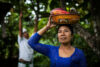
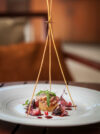
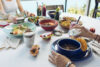



Bali, Thailand, Malaysia, Vietnam – different climates, the same overwhelming intensity. Colors I didn’t know existed. And food everywhere, all the time. Not as a meal, as a way of life. Eating is the most important thing one does. Work is what happens between meals.
In the buildings I worked on, flowers were treated as architecture. Birds-of-paradise standing in corners like columns. Heliconias suspended in stairwells. Orchids set into stone. Frangipani laid across thresholds. Flowers carried weight – not the finish, the structure.
The food worked on two registers. A halved papaya with a wedge of lime. A bowl of rice with one perfect prawn. Textures that needed no ornament. And, within walking distance, a fine dining scene as ambitious as any in the world. Peasant and laboratory, market and atelier, side by side.
Even breakfast became a discipline of color. Papaya, dragon fruit, mango, mint, one edible flower on a plate by the sea: composition, not nutrition.
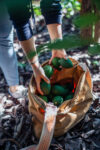
Later, far from Asia, a different lesson – on an avocado farm in Portugal. I thought I knew avocado. I didn’t. Most of what reaches a supermarket is picked early, ripened in a truck, almost unrelated to a fruit cut at its moment from the tree. The food chain is mostly compromise. The real ingredient is rare.
The first time I saw a thousand frames per second, time slowed enough to reveal a decision. A drop before it meets the surface. Salt in the air. A crunch becoming a sentence. I knew I had to be on the side of the set where that was made.
My first time at Bites Studio was a remote shoot with director Ruben Latre – a Maggi project. I stood at the back of the room and watched. Years of architecture, years of Asian kitchens, and still – I had never seen anything quite like it.
Food filmmaking is its own craft. Its own physics, its own rhythm, its own vocabulary. Food stylists who produce six identical burgers at four in the morning. SFX specialists for whom “exploding chocolate” is a fluid-mechanics task. Motion-control robots repeating the same move a thousand times, to the millimeter. The tomato on screen is almost never the tomato you think you see. It is a translation, from matter into image.

Why food, then. Because food is not neutral. Italian ragù has a different dramaturgy than Japanese miso. A croissant moves at a different tempo than a Polish pączek. Salsa pulses. Kimchi ferments. Hummus spreads like a landscape. To film food is to film a whole civilization standing behind a single ingredient.
That is why this work will probably never bore me. Every project is a new culture entering through the kitchen door – the most intimate door any nation has. You can lie with politics, with fashion, with architecture. With food, almost never.
I started with no connections. Twice. Maybe that’s why this work fits. Every kitchen teaches the same thing – sit at the table long enough, and someone will hand you a spoon.


